🥇The radar with two cameras and the most named readings
38/60our score
Radar plus two cameras, with slow-motion views of club and ball contact
Its catch: Four readings behind a plan; no tolerance printed
Garmin R10 vs Rapsodo MLM2PRO
This article contains affiliate links, at no cost to you.
Quick read
Take the Garmin Approach R10 if you carry the unit to the range and want printed tolerances: 0.7 lb, IPX7, up to 10 hours of battery. Take the Rapsodo MLM2PRO if you want spin axis, club path and a camera pair, and you accept a membership at $199.99 a year. Both score 38 out of 60 on our scale, so the choice is about the buyer, not the total.
Two portable radars that tie at 38 out of 60 and split on printed tolerances, readings and the membership.
🥇The radar with two cameras and the most named readings
38/60our score
Radar plus two cameras, with slow-motion views of club and ball contact
Its catch: Four readings behind a plan; no tolerance printed
🥈The lighter radar, with four tolerances printed
38/60our score
The only one of the two that prints tolerances: 1 mph on ball speed, 3 mph on club head speed, 1 degree on launch angle and direction
Its catch: Plan price not printed; five readings named
🥉The best all-round pick: 43 of 60, 20 metrics named, no yearly fee, and the only one of the three leaders whose maker writes both distances (8 ft behind the ball, 8 ft to the net)
43/60our score
20 metrics named in the title, chipping and putting parameters among them
Its catch: 16 ft of total depth is a lot for a garage, and the maker says less than that can give inaccurate tracking
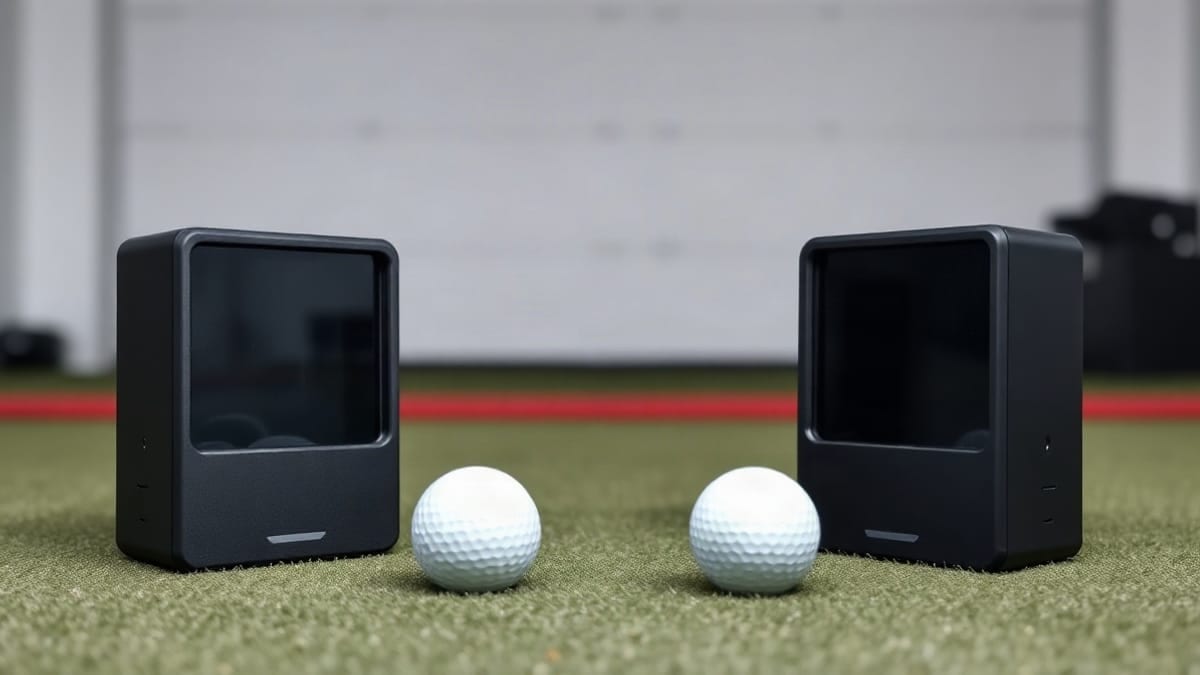
Two small radars, a phone, a net and about 15 ft of floor: the bay looks the same whichever one you pick, and the scores agree, 38 out of 60 each. Yet the two units are not twins, and we spent our time on the lines where they split.
Garmin R10 vs Rapsodo MLM2PRO is a pick between a lighter radar that prints its tolerances and a heavier radar-plus-camera unit that holds four readings behind a membership. We read both makers' manuals and pages line by line, worked out the room depth and the membership sums ourselves, and found two different buyers behind one tie.
Neither wins on the total, so the answer depends on who is swinging. The four cards below name the buyer each unit fits. After them come the figures, the six scores line by line and the criteria that decide it.
Rapsodo MLM2PRO. Its page names spin rate, spin axis and club path, and a 15-metric count against Garmin's "more than a dozen".
Garmin R10. It prints 1 mph on ball speed, 3 mph on club head speed, 1 degree on launch angle and 1 degree on launch direction. Rapsodo prints none.
Garmin R10. At 0.7 lb it is 0.3 lb lighter than the 1 lb Rapsodo, with IPX7 water resistance and up to 10 hours of battery.
Rapsodo MLM2PRO. Its membership prices are printed: $199.99 a year for Core, or $599.97 over three years.
Nothing here is a knockout. If your swing is the project, take the Rapsodo for the extra readings. If portability and a written margin of error matter more, take the Garmin.
Quick read
Both are radars with a phone app and both want about 8 ft of net distance. The gaps are in weight, printed tolerances and battery; what a plan holds back has its own table further down.
| Figure | Garmin Approach R10 | Rapsodo MLM2PRO |
|---|---|---|
| Technology | Radar | Doppler radar plus two cameras |
| Weight | 0.7 lb (340 g) | 1 lb (16 oz) |
| Behind the ball | 6 to 8 ft | 6.5 to 8.5 ft |
| Ball to net, indoors | At least 8 ft | 8 ft |
| Room depth | 14 to 16 ft | 14.5 to 16.5 ft |
| Metrics | "More than a dozen", five named | 15 in the bullets, 13 in the description |
| Printed tolerances | 1 mph, 3 mph, 1 degree, 1 degree | None |
| Battery | Up to 10 hours | Not stated |
| Water | IPX7 | Not stated |
| Warranty | 1 year limited | 1 year |
Figures come from each unit's Amazon.com page, read on November 16, 2026, and from Garmin's manual and Rapsodo's FAQ; the room depth is our sum of the two distances each maker gives. Prices of the units are left out because they change.
Because each unit wins two lines and the lines cancel out. Our scale scores six criteria out of 10, and the unit that wins one criterion loses another by the same margin.
| Criterion | Garmin R10 | Rapsodo MLM2PRO | Who leads |
|---|---|---|---|
| Performance | 8 | 9 | Rapsodo |
| Fit for the room | 6 | 6 | Tie |
| Build and durability | 5 | 4 | Garmin |
| Setup and ease | 6 | 7 | Rapsodo |
| Running costs | 5 | 4 | Garmin, with a catch |
| Warranty and info | 8 | 8 | Tie |
The catch sits on the Running costs line. Garmin earns a 5 because it ties its courses to a subscription and prints no price, while Rapsodo earns a 4 because its membership has a price on the page. That is a gap in what we could read, not a cheaper plan. A total that rests on one such point cannot rank two units. We rank them by profile instead.
Edge: Garmin R10, on paper only. Garmin prints four tolerances: plus or minus 3 mph on club head speed, 1 mph on ball speed, 1 degree on launch angle and 1 degree on launch direction. Rapsodo's pages claim pro-level accuracy and give no figure. We have not measured either unit, so a printed tolerance is the maker's claim and no more.
Here is what Garmin's numbers mean (page read November 16, 2026): a 1 mph error on a 150 mph ball is 0.7%, and 3 mph on a 100 mph swing is 3%. A launch direction error of 1 degree over a 150 yd carry (450 ft) is about 7.9 ft sideways, which is 450 ft times the tangent of 1 degree. If Rapsodo prints a tolerance elsewhere, we did not find it on the pages we read, and the same goes for how accurate the unit is outdoors.
Edge: Rapsodo MLM2PRO, by a small margin. Rapsodo's page names spin rate, spin axis, carry distance, club speed, club path and launch angle, and its FAQ adds ball speed and attack angle. Garmin names club head speed, ball speed, swing tempo, ball spin and launch angle, and then says "and more" without a list. The two Rapsodo counts disagree with each other, 15 and 13, so the real gap may be two or three readings.
Edge: Garmin R10, but we can't call the money. Garmin's page ties virtual rounds and a weekly tournament to an active subscription and says nothing of a plan for training mode, the dispersion chart or swing clips. Rapsodo holds back four readings: spin rate, spin axis, attack angle and club path. Garmin locks less data. Rapsodo is the only one of the two whose price you can read, against a Garmin figure that neither the manual nor the product page gives.
| What a plan touches | Garmin R10 | Rapsodo MLM2PRO |
|---|---|---|
| Carry distance and ball speed | Free, no plan named | Free in practice mode |
| Spin rate, spin axis, attack angle, club path | No plan named | Membership |
| Virtual rounds and courses | Garmin Golf subscription | Membership, with a 21-day trial |
| Printed price over three years | Not printed | Core $599.97 |
Tie. The Garmin R10 asks for 6 to 8 ft behind the tee and 8 ft to the net, 14 to 16 ft in all. The Rapsodo asks for 6.5 to 8.5 ft and 8 ft, 14.5 to 16.5 ft. Half a foot separates them. Rapsodo adds that taller players may have to set the unit farther back to capture the whole swing on video. For the ceiling, Rapsodo's own guide gives 9 ft as a minimum and 10 to 11 ft for taller golfers, while Garmin gives no number. Our rule is your height plus 48 in at the driver: 120 in, or 10 ft, for a golfer of 6 ft. Our room size guide does the sum for your own bay.
Edge: Garmin R10. It weighs 0.7 lb against 1 lb, carries an IPX7 rating and runs up to 10 hours. Rapsodo's pages give no battery life or water rating that we found. For a bay that never leaves the garage the gap barely matters. For a bag that goes to the range every week it does.
You split your practice between a net at home and the driving range, you want a margin of error in writing, and you are content to read Garmin Golf's current plan before you count on virtual rounds. It also fits a shorter bay, since 14 ft is enough if you stay at the near end of both distances.
You are fixing a particular fault, such as a path that cuts across the ball, and you want spin axis and club path on every shot. It fits a golfer who has already done the three-year membership sum and still likes the course library, and who has at least 14.5 ft of depth.
Both start on the floor behind the ball and both pair with a phone. On the Garmin, you set the unit on the ground 6 to 8 ft behind the tee, put the tee at least 8 ft from the net, and keep the bottom edge of the unit above the mat. Garmin's hitting area is 2 by 2 ft and begins 6 ft from the unit. Shade the front of the unit from direct sun, which can cause misreads.
On the Rapsodo, you put the unit on its tripod 6.5 to 8.5 ft directly behind the ball, aimed down the target line, and register it so practice mode works. In Session Setup, choose Net when you hit into a net and Range when you watch the full flight. Indoor spin appears only in Net mode with an RPT ball. Our indoor setup guide covers alignment and lighting for both.
We would take the Rapsodo MLM2PRO for a golfer who wants more readings and the course library, and the Garmin R10 for a golfer who wants a lighter unit and a printed tolerance. The scores tie at 38 because each unit leads on two lines. The Rapsodo gives you spin axis, club path and two cameras for 0.3 lb more and a membership whose price you can read. The Garmin gives you tolerances, IPX7 and a longer battery for fewer named readings and a plan price you must look up.
Read the full figures on the Garmin Approach R10 page and the Rapsodo MLM2PRO page, or see both among the other radars in our best golf launch monitor guide. If depth is your only worry, the FlightScope Mevo Gen2 against the R10 adds a no-fee option.
Every figure starts on the Amazon.com pages of the Garmin R10 and the Rapsodo MLM2PRO (title, bullets and technical rows, November 16, 2026) and is then checked against Garmin's owner's manual, Rapsodo's FAQ and its ceiling height guide. The units have never been in our hands, and no customer rating appears here. A search of the CPSC recall database that day turned up nothing for either brand.
It is good at the readings it names: radar plus two cameras, 15 metrics by one count and 13 by another. Whether it pays off depends on the plan. Practice mode is free and shows carry distance and ball speed. Core costs $199.99 a year, $599.97 over three, and our subscription costs guide sets that against the other brands.
Yes, with a membership. The page ties its 30,000 simulated courses to Premium, and the 21-day trial that comes with the unit opens them for three weeks. After the trial, free practice mode still shows carry and ball speed, but courses need a plan.
It is, for a modest one. Garmin says an active subscription opens virtual rounds on over 42,000 courses, and its manual says over 43,000. The unit sends its radar numbers to the phone, so the screen is the phone's. For a projector and a big screen, check what your software accepts first.
On this site, three radars. The Rapsodo MLM2PRO is this page. The FlightScope Mevo Gen2 has no subscription, and the Shot Scope LM1 asks for 4 to 5 ft behind the ball, a trade we weigh in Shot Scope LM1 vs Garmin R10. The SkyTrak ST MAX sits beside the ball.
Rapsodo's page names spin rate, spin axis, carry distance, club speed, club path and launch angle, and its FAQ names ball speed and attack angle. Spin rate, spin axis, attack angle and club path need a membership.